Sweater on Shoulders Outfits That Feel Modern
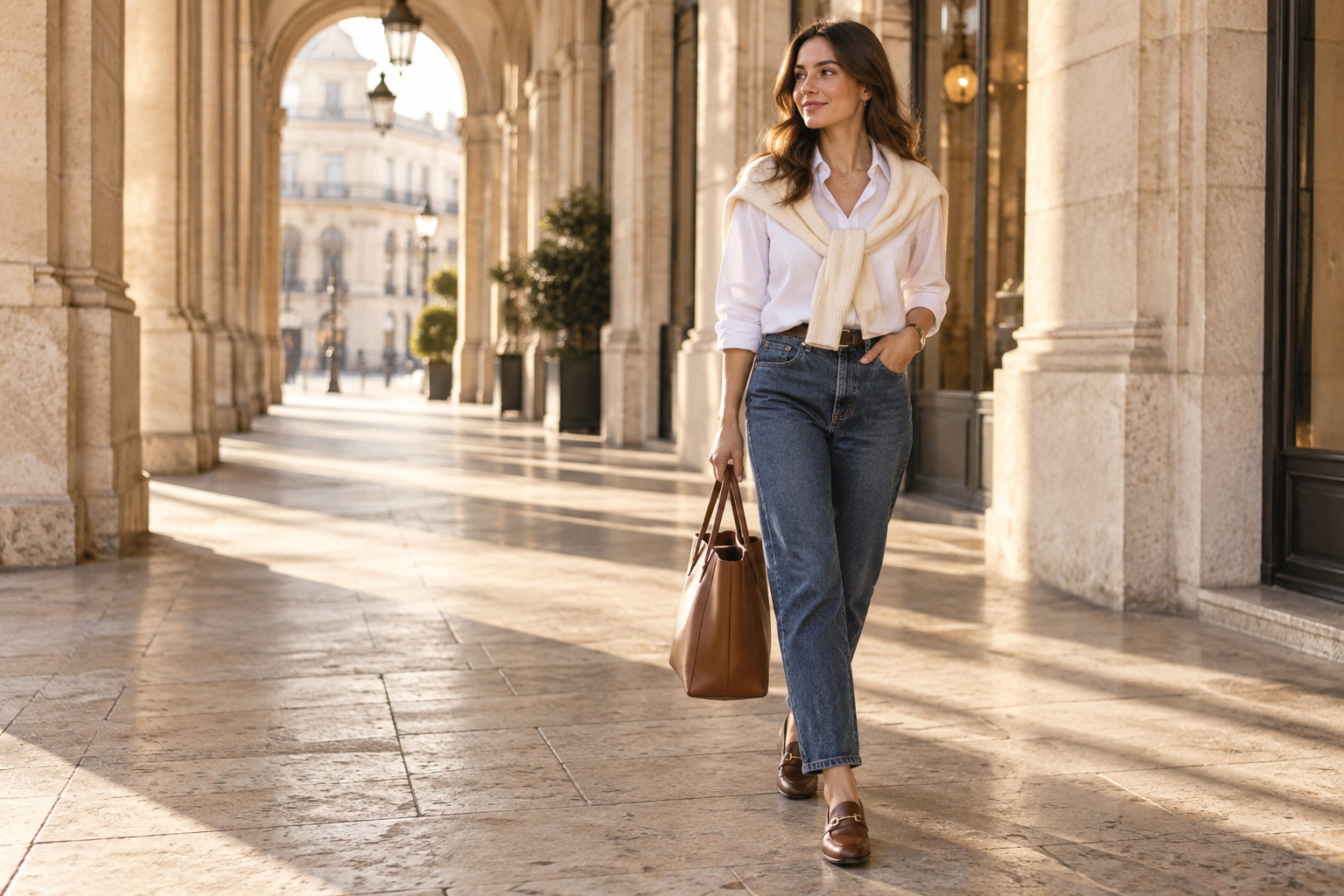
A sweater draped over your shoulders can make a simple outfit look considered in seconds. It adds color, texture, and a light layer without changing the clothes you are already wearing. The trick is making the gesture look intentional instead of like you forgot where to put your sweater.
The best sweater on shoulders outfits balance three things: the weight of the knit, the shape underneath, and the way the sleeves are secured. A fine merino knit can sit neatly over a button-down. A chunky cable knit can soften tailoring. A striped cotton sweater can give jeans and a T-shirt a clear point of view. Once you understand those relationships, the styling move becomes much more flexible than its old preppy reputation suggests.
Why sweater-on-shoulders outfits are having another moment
The appeal is partly practical. Weather often changes during the day, especially when you leave a warm home for a cool morning, spend time in a heated building, and go back outside at night. A sweater across your shoulders gives you an extra layer nearby without making you commit to wearing it. You can put it on when the temperature drops, carry it over one arm, or retie it when you move from a casual setting to a more polished one.
The Fashion-Note Edit
Five effortless pieces to refresh your everyday wardrobe
A polished, practical edit for workdays, weekends, and everything in between.

The Drop
Women’s Blake Long Blazer
A longline, tailored blazer with a notched collar and a single-button closure—an easy layer for denim, dresses, or office-ready looks.
Shop the blazer
Amazon Essentials
Women’s Lightweight Crewneck
A soft, lightweight sweater with a clean crew neckline—the kind of reliable layer that works from cool mornings to air-conditioned spaces.
Shop the sweater
Amazon Essentials
Women’s Loafer Flat
A classic flat loafer that gives casual outfits a more polished finish and pairs naturally with tailored pants, skirts, and straight-leg jeans.
Shop the loafers
Levi’s
Women’s 501 90s Jeans
A relaxed, vintage-inspired take on the iconic 501 silhouette—made for an easy, lived-in look without the thrift-store search.
Shop the jeans
Colorfulkoala
High-Waisted 7/8 Leggings with Pockets
Soft, four-way-stretch leggings with side pockets and a high-rise waistband—designed for movement, errands, and off-duty comfort.
Shop the leggings
Affiliate disclosure: This section contains affiliate links. If you make a purchase through these links, I may earn a commission at no additional cost to you. Product selection, pricing, availability, and delivery terms may change—please review the current details on Amazon before purchasing.
As an Amazon Associate I earn from qualifying purchases.
The visual appeal is just as important. A sweater creates a horizontal line around the neck and upper chest, which can make a plain outfit feel finished. It introduces a second texture near a shirt collar, a third color against a coat, or a relaxed contrast against tailored trousers. That small layer can also make an outfit feel more personal because it gives the eye something to notice beyond the main top and bottom.
Your wedding style is personal.
Your plan should feel that way, too.
Zarellea keeps your guest list, budget, vendors, and every next step beautifully organized — so you can focus on the moments that feel like you.
Older versions of the look were strongly associated with collegiate dressing, country-club references, and a very specific idea of polished style. That history is still part of the visual language, but it is no longer the only way to wear it. A charcoal sweatshirt over a white tee and loose jeans reads casual. A red knit over a navy blazer reads expressive. A slim cardigan over a floral dress reads useful and romantic. The same action can communicate different moods when the fabric, color, and outfit underneath change.
Recent styling coverage has also moved the sweater from a strictly functional item to a flexible accessory. It may be worn around the neck like a soft scarf, loosely draped over a coat, or tied with the sleeves shifted slightly to one side. The modern version is less about looking perfectly arranged and more about creating a relaxed line that still respects proportion. That is why the gesture works with wide-leg pants, oversized blazers, simple dresses, and casual denim.
There is one useful mindset shift: do not treat the sweater as an extra piece that has to compete with the outfit. Treat it as a styling frame. Its job may be to repeat a color, break up a long column of neutral clothing, soften a sharp jacket, or add a small amount of warmth. When it has a clear job, the result looks natural even if the sweater never gets worn in the conventional way.
- Use a sweater to repeat one color already present in the outfit.
- Use texture to make a smooth shirt or coat feel less flat.
- Use a knot when movement or wind would make a loose drape frustrating.
- Use a relaxed drape when the outfit already has enough visual detail.
Choose the right sweater and the right drape
Start with fabric weight. A medium-weight knit is the easiest all-purpose choice because it has enough body to sit across the shoulders while remaining comfortable to carry. Merino wool and fine cashmere tend to create a clean, fluid line. Cotton knits can look crisp and relaxed. A chunky cable knit makes a stronger statement but needs room around it, especially if the outfit includes a blazer or a coat.
Next, check the sweater’s proportions. A slightly relaxed crew neck usually works better than a very fitted sweater because the sleeves can reach the front without pulling the body tight across your back. A cardigan gives you softer edges and can be left open when you want the neckline to feel less preppy. Avoid a sweater so oversized that the shoulders slide toward your elbows. The look should be loose, not unstable.
When to use the classic drape
The classic drape is the simplest option. Place the sweater across the back of your shoulders, let the sleeves fall forward, and adjust the neckline so it sits near the base of your neck. This is best when the outfit underneath is already strong, such as a printed dress, a striped shirt, or a tailored suit. A no-tie drape keeps the overall effect quiet and lets the knit act more like a soft stole.
To keep it from sliding, do not place the sweater too far back. The shoulder seams should sit close to your natural shoulder line, and the body of the sweater should rest across your upper back. If the sleeves are dramatically different in length, move the neckline slightly until both sides look balanced. A small imbalance can feel relaxed, but a large one usually reads accidental.
When to tie the sleeves in front
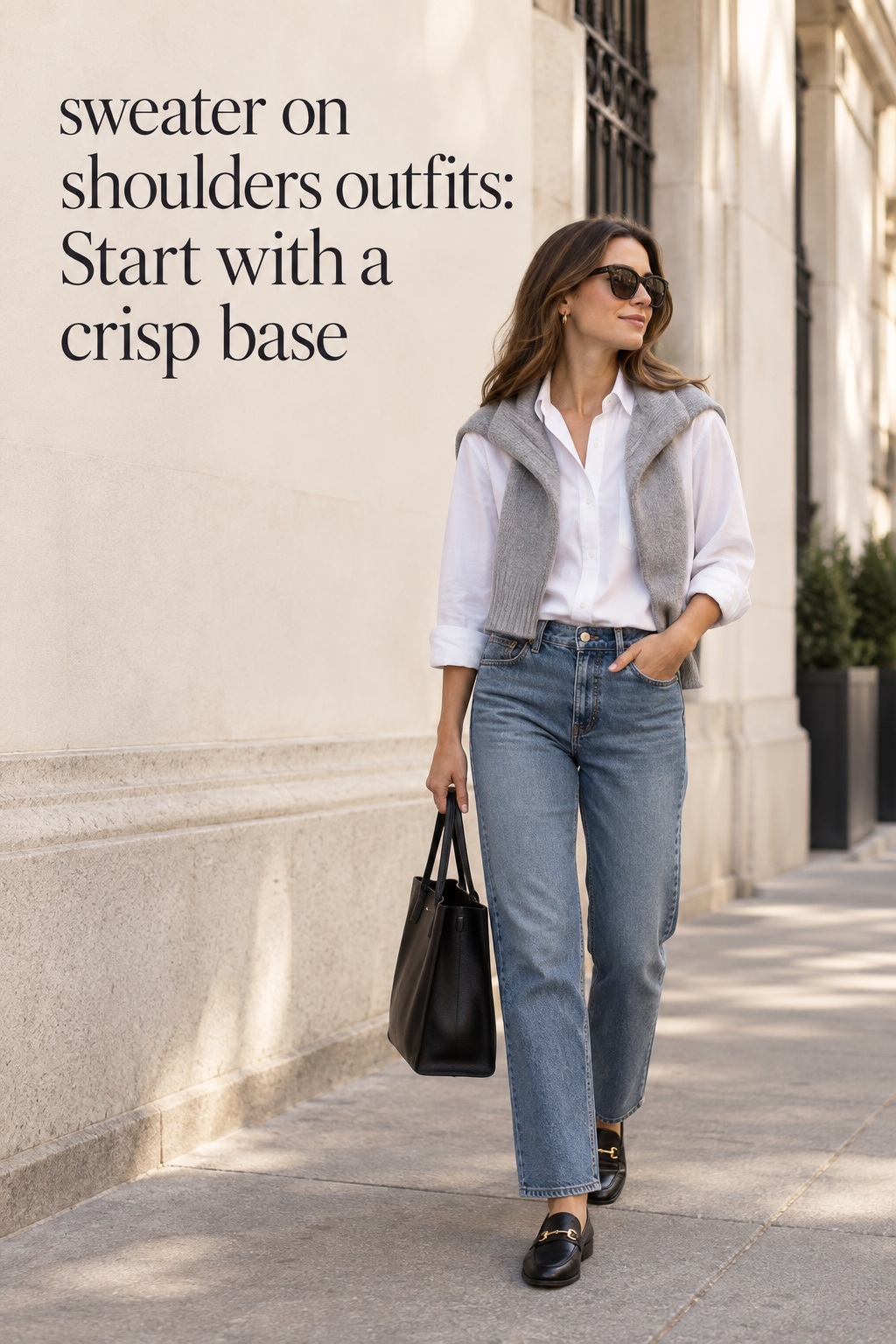
A front knot is useful when you are walking, commuting, or carrying a bag. Bring the sleeves forward and tie a simple knot at chest level. Keep it loose enough that the knit does not bunch into a hard ball. You can position the knot in the center for a classic effect or move it slightly to one side for a less formal finish.
The knot changes the proportions of the outfit. A high knot draws attention toward the face and collar. A lower knot creates more length through the torso but may compete with a belt or a high waistband. If you are wearing a blazer, leave enough room for the lapels to remain visible. If the shirt underneath has a dramatic collar or bow, use a thin sweater and a loose tie so the neckline does not become crowded.
When to try a one-shoulder or cross-body toss
The one-shoulder toss is the most casual version. Begin with a loose drape, then move one sleeve over the opposite shoulder while the other hangs forward. It creates a diagonal line and works well with jeans, sneakers, a simple tee, or a relaxed outdoor outfit. Because the shape is intentionally uneven, it is better with clothes that already feel easy rather than with a sharply tailored suit.
A cross-body loop is more secure for breezy days. Each sleeve travels under the opposite arm and back over the shoulder, creating a soft wrap around the upper body. This method adds bulk, so keep the base outfit streamlined. It can be especially useful with a fine knit over a shirt when you want the sweater to stay put but do not want a visible front knot.
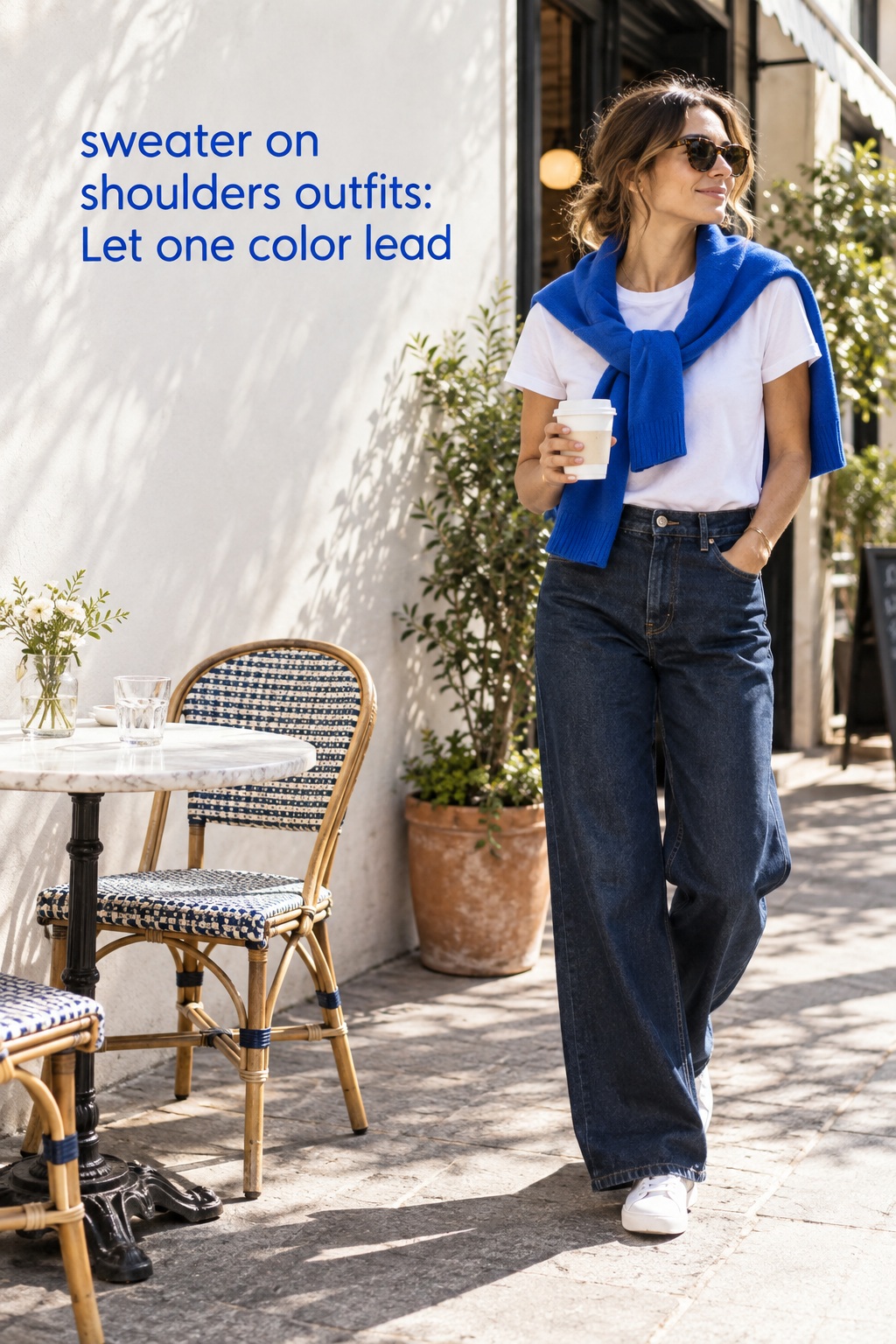
Color should support the method. A neutral knit makes an unusual toss feel calmer. A bright knit makes the drape itself the focal point, so the rest of the outfit can be quieter. Stripes and small patterns are effective when the clothing underneath is solid, but they need clear negative space around them. If the base outfit already has a print, choose a solid sweater or a very subtle texture.
Five sweater on shoulders outfits to copy
1. White button-down, straight jeans, and a soft gray knit. This is the reliable starting point because the shirt collar gives the sweater a clear anchor. Wear a slightly relaxed white button-down, straight-leg jeans, and loafers or clean sneakers. Drape a gray, navy, or oatmeal crew neck over the shoulders. The contrast between the crisp shirt and soft knit makes the outfit look finished without becoming formal. Leave the shirt untucked for ease, or tuck only the front if you want more definition at the waist.
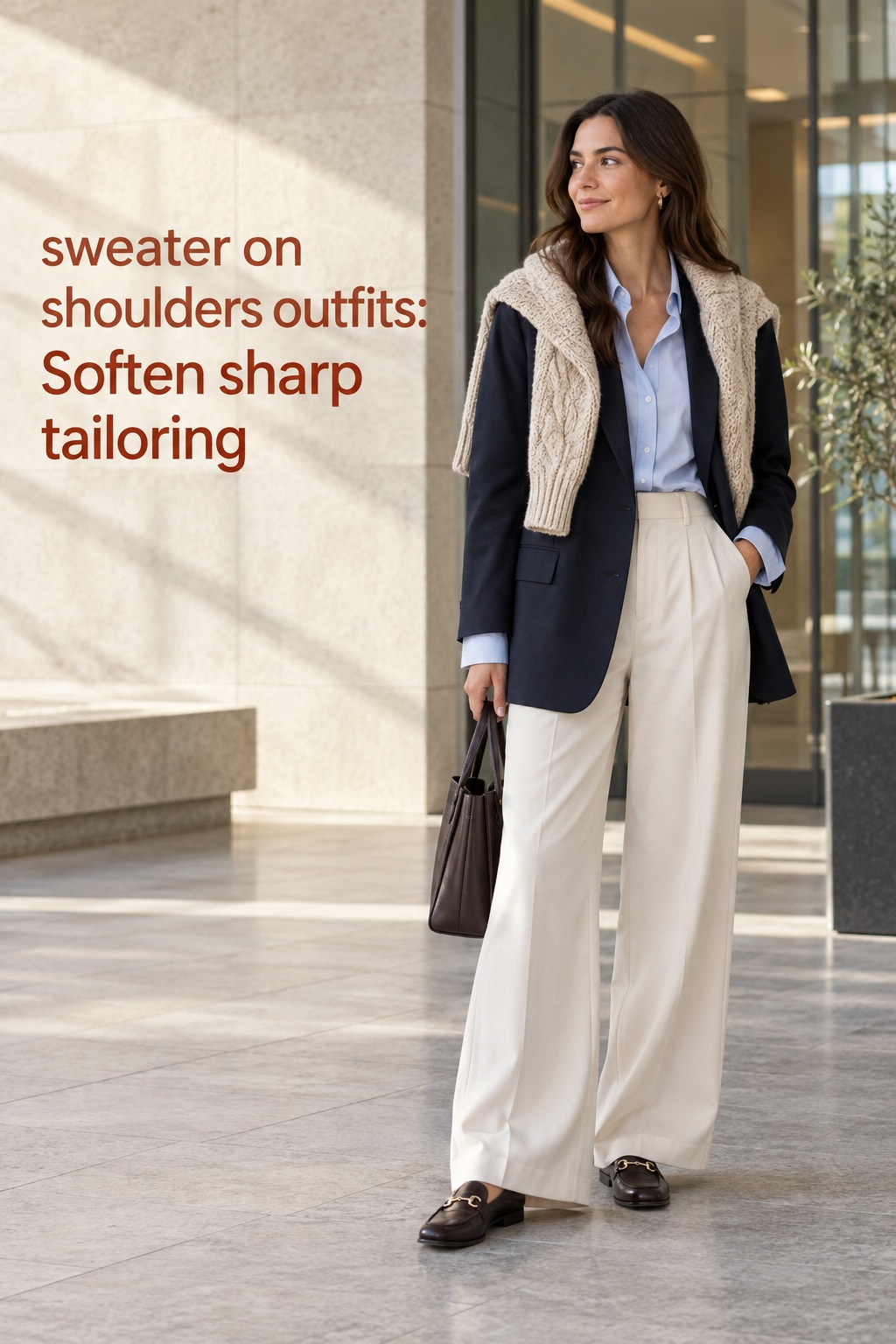
2. Oversized blazer, wide-leg trousers, and a cable-knit sweater. A roomy blazer can look severe when paired with equally polished separates. A cable knit introduces a tactile, relaxed note. Choose a sweater in cream, camel, or a muted color that relates to the blazer. Let it drape rather than tying it tightly, and keep the shirt underneath simple. Pointed flats, loafers, or low boots ground the tailored base while the sweater makes the outfit feel approachable.
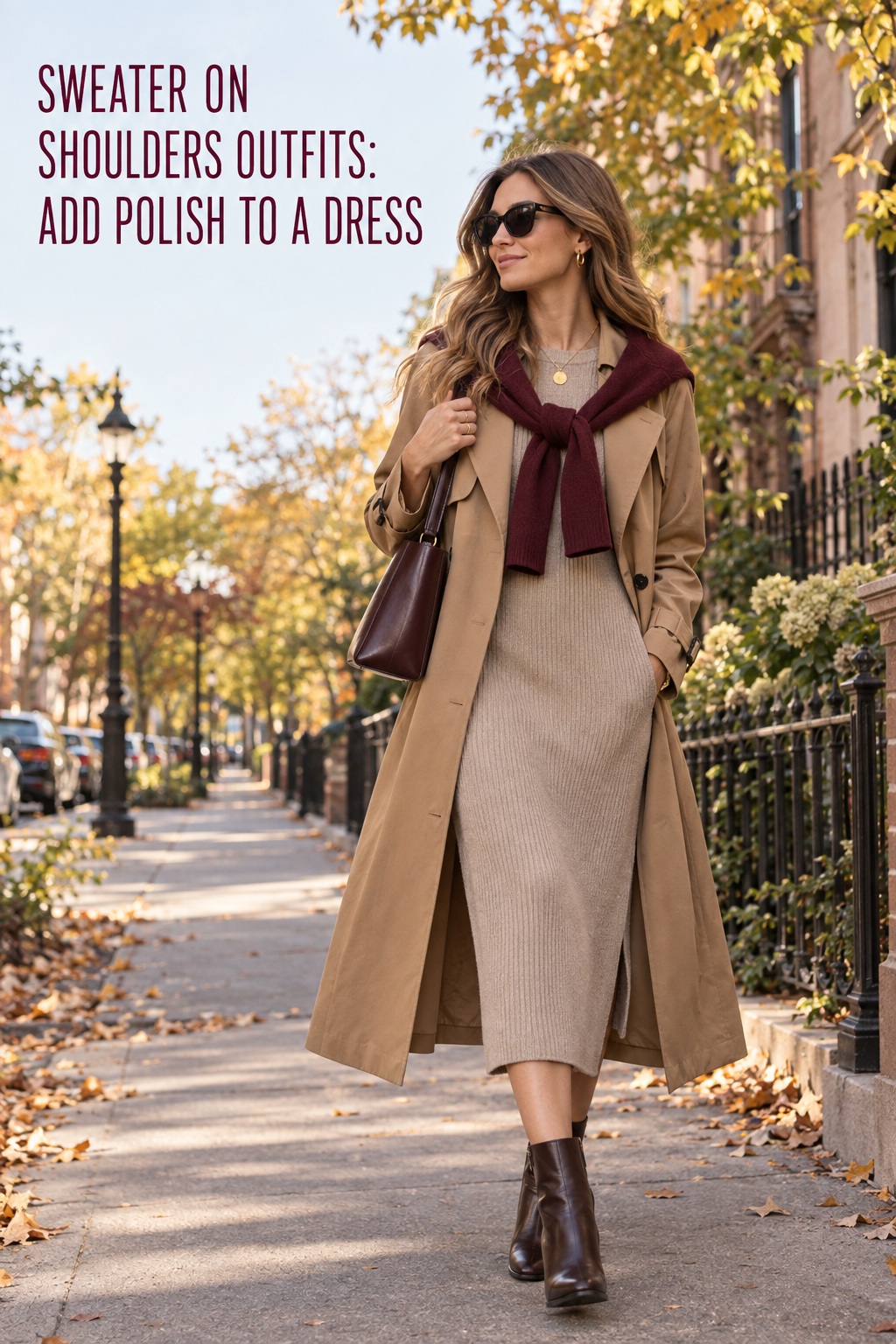
3. Trench coat, knit dress, and a matching shoulder layer. A sweater around the shoulders can make a dress and trench combination feel less predictable. Try a fine cardigan or crew neck in a color pulled from the dress, then knot the sleeves loosely near the collarbone. The repeated color creates cohesion while the trench gives the outfit structure. This formula is useful in transitional weather because the knit can become a real layer when the coat comes off.
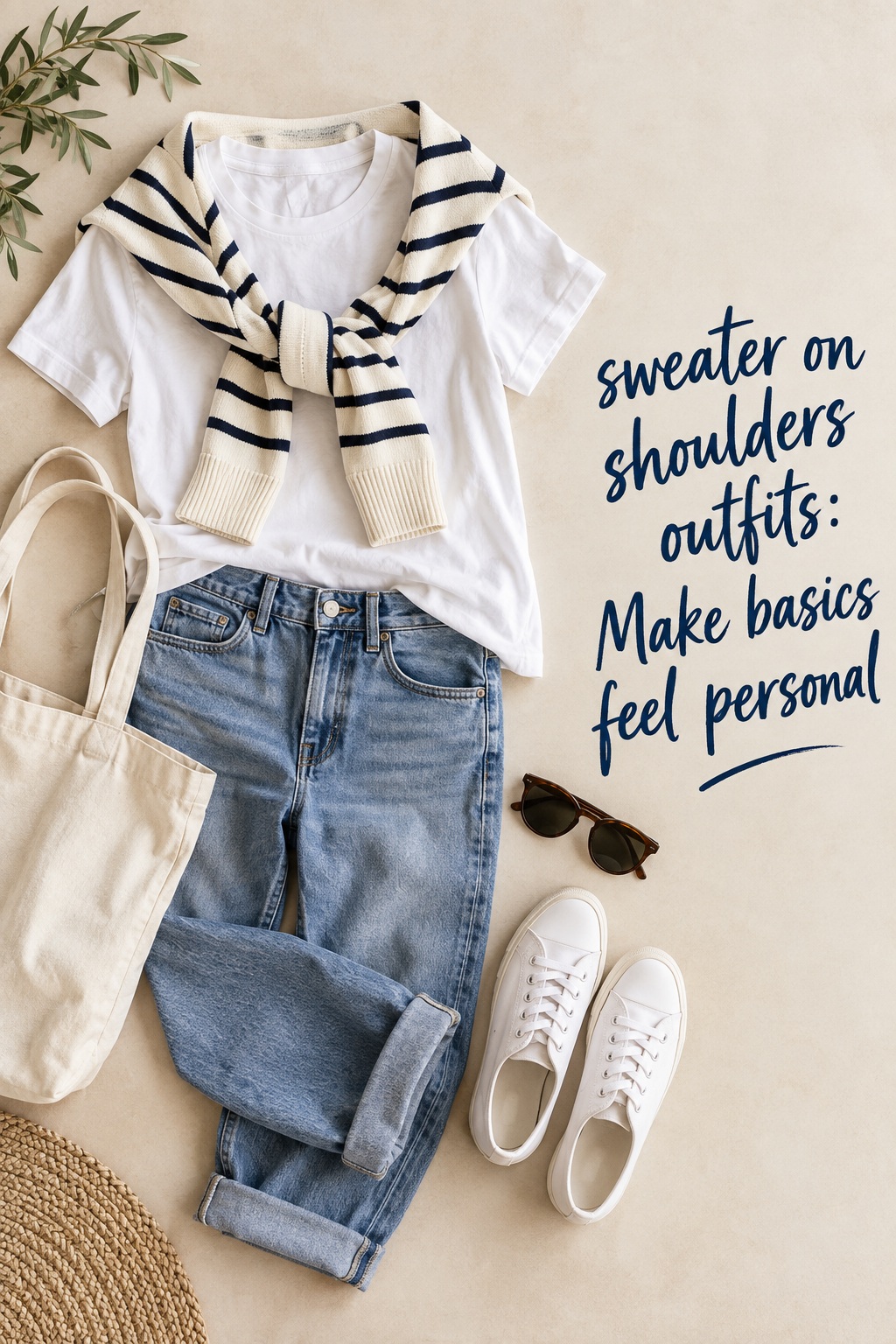
4. T-shirt, relaxed denim, and a striped cotton sweater. For a casual weekend outfit, let the sweater provide the personality. Start with a clean white or navy T-shirt, loose straight or wide-leg jeans, and simple flat shoes. Choose a striped knit and place it over the shoulders without a knot. A canvas tote or small crossbody bag keeps the look practical. Because the stripes already create movement, avoid adding a busy necklace or a second prominent print.
5. Slip dress, flat shoes, and a compact cardigan. The sweater does not need to make a dress look preppy. A fine cardigan draped low around the shoulders can add softness and make a slip dress easier for daytime. Keep the knot relaxed or leave the cardigan open if it has buttons. Add ballet flats, sleek sneakers, or flat sandals according to the season. The most important detail is scale: a thin knit preserves the line of the dress, while a bulky sweater may overwhelm it.
These formulas are starting points, not uniforms. Change the finish by changing only one variable at a time. Swap a crew neck for a cardigan, a centered knot for an uneven drape, or a neutral knit for a color accent. You can also repeat the sweater color in a bag, socks, or shoes to make the outfit feel deliberate. The goal is not to add more pieces. It is to give the one extra piece a clear relationship to what is already there.
- For polished outfits, choose a smooth knit and a centered or gently off-center knot.
- For relaxed outfits, choose cotton, stripes, or a casual toss.
- For dresses, keep the sweater lighter than the dress unless you want a deliberate contrast.
- For tailoring, use texture to soften the outfit but leave the lapels and waistband visible.
- For denim, let the sweater supply the color or pattern that makes the basics feel personal.
Make the styling move look intentional
Proportion is the first checkpoint. Look at the outfit from a distance and ask whether the sweater is framing the upper body or swallowing it. If the sleeves end near the widest part of your torso, try tying them higher or choosing a lighter knit. If the sweater creates too much volume at the neck, open the shirt collar slightly or remove another high-contrast accessory. Small changes often make more difference than replacing the whole outfit.
Security is the second checkpoint. A loose drape should feel comfortable, but it should not require constant adjustment. If the sweater slips, move it closer to the neck, try a front knot, or use the cross-body loop. A very smooth fabric can be difficult to keep in place, while a textured knit usually grips clothing underneath more easily. Do not make the knot painfully tight. A strained knot looks less natural and can stretch the sleeves.
Consider your bag. A shoulder bag can catch on the sweater sleeve and pull the drape out of position. A crossbody can create another diagonal line that competes with a one-shoulder toss. If the bag is large or heavy, use a centered knot or a secure loop. With a small hand-held bag, you have more freedom to let the sweater fall loosely. This is a practical detail that keeps the outfit looking good while you move through the day.
Match the finish to the setting. A front knot over a collared shirt can work for a casual office, especially with tailored trousers and polished shoes. For a formal event, a sweater may be better carried or worn as a true layer unless the setting clearly welcomes relaxed styling. For travel, prioritize comfort and security. For a coffee run, a loose drape and sneakers can look easy. The same sweater can work in several places when the rest of the outfit changes its message.
Avoid over-explaining the look with too many preppy signals at once. A cable knit, striped shirt, loafers, headband, pleated skirt, and crest detail can push the outfit toward costume. Pick one or two references and balance them with modern shapes such as relaxed jeans, an oversized coat, flat sneakers, or a simple leather bag. The strongest sweater on shoulders outfits usually have one classic detail and one easy, current proportion.
Finally, check the neckline and the face. The sweater should not cover your hair, pull against earrings, or create a bulky ridge beneath a coat collar. Keep the visual weight close to the shoulders and let the face remain open. If the knit is large, simplify the jewelry. If the sweater is thin and plain, a scarf, pendant, or textured bag can add the interest that the knit is not providing.
Sources and methodology
This guide was shaped by a review of ten English-language styling pages covering sweater draping methods, fabric weight, practical layering, preppy references, current outfit formulas, and ways to adapt the look for women’s casual, tailored, and dress-led wardrobes. The recommendations here are editorial styling guidance. They do not claim personal testing, product ownership, or a universal dress code.
FAQ
What is the easiest way to wear a sweater over your shoulders?
Use the classic drape. Place the sweater across the back of your shoulders, keep the neckline near the base of your neck, and let the sleeves fall forward. Adjust both sides until the length looks balanced. A medium-weight crew neck is the easiest starting point because it has enough structure to stay visible without creating too much bulk.
Should the sweater on your shoulders be tied?
Not always. Leave it untied when the outfit is already detailed or when you want a softer, quieter finish. Tie the sleeves when you need more security, are carrying a bag, or want the sweater to become a stronger focal point. A loose knot usually looks more relaxed than a tight, perfectly centered knot.
What type of sweater works best for shoulder draping?
Medium-weight crew necks, fine merino knits, cotton sweaters, and relaxed cardigans are versatile choices. Heavy cable knits can work over simple clothing or tailoring, but they need enough room around the neck and shoulders. Extremely slippery, tiny, or oversized sweaters are usually harder to keep balanced.
Can you wear sweater on shoulders outfits in warm weather?
Yes. Choose a lightweight cotton, linen-blend, or fine-gauge cardigan and pair it with a dress, tank, T-shirt, or relaxed trousers. In warm weather, the sweater is mainly a color and texture accessory, with the option of becoming useful in air conditioning or after sunset. Keep the knit light so the outfit does not look visually heavy.
How do you stop a sweater from slipping off your shoulders?
Move the sweater slightly closer to your neck, choose a textured or medium-weight knit, or secure the sleeves with a loose front knot. A cross-body loop gives even more stability on windy days. Check that the sweater is not so oversized that the shoulder seams fall toward your elbows. If a coat or bag is pulling it out of place, change the carrying method.
Do sweater on shoulders outfits look too preppy?
They can look preppy, but the rest of the outfit controls the message. Pairing the sweater with a collared shirt, pleated skirt, and loafers emphasizes that reference. Pairing it with loose jeans, a simple tee, sneakers, or a relaxed coat makes it feel more casual and current. Use one classic detail and balance it with an easier silhouette if you want a less formal result.
Finish the look
The little extras that make a summer outfit feel complete
From beach days to city weekends, these easy pieces bring comfort, texture, and a polished finishing touch.

FENBEN
Straw Hobo Crossbody Bag
A handwoven straw bag with both short and crossbody straps—an effortless finishing touch for vacation looks and warm-weather outfits.
Shop the bag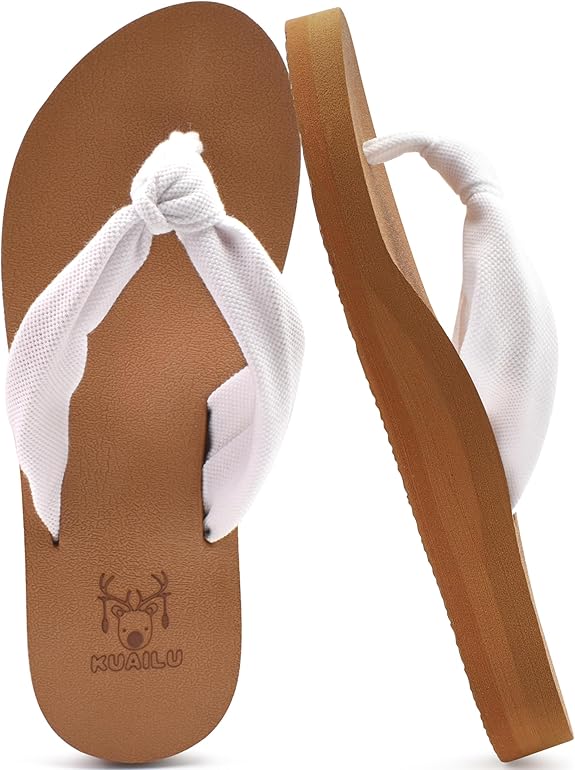
KuaiLu
Flip Flops with Arch Support
Cushioned, lightweight sandals with supportive arch design—a practical choice for beach trips, errands, and long summer walks.
Shop the sandals
baleaf
Athletic One-Piece Swimsuit
A functional one-piece with adjustable straps and moderate coverage, designed for swimming, training, surfing, and active beach days.
Shop the swimsuit
Astylish
Linen-Cotton Button-Down Shirt
A relaxed cotton-linen shirt with a collared V-neck and roll-up sleeves—easy to style over swimwear or with denim and shorts.
Shop the shirt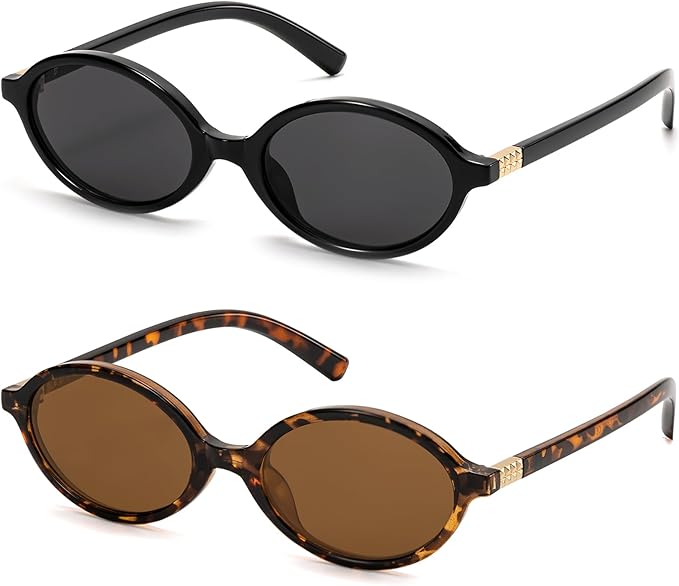
ViewJoy
Retro Oval Sunglasses
Small oval sunglasses with a 90s-inspired silhouette and UV400 lens protection—a quick way to add a vintage edge to everyday looks.
Shop the sunglasses
Affiliate disclosure: This section contains affiliate links. If you make a purchase through these links, I may earn a commission at no additional cost to you. Product selection, pricing, availability, and delivery terms may change—please review the current details on Amazon before purchasing.
As an Amazon Associate I earn from qualifying purchases.