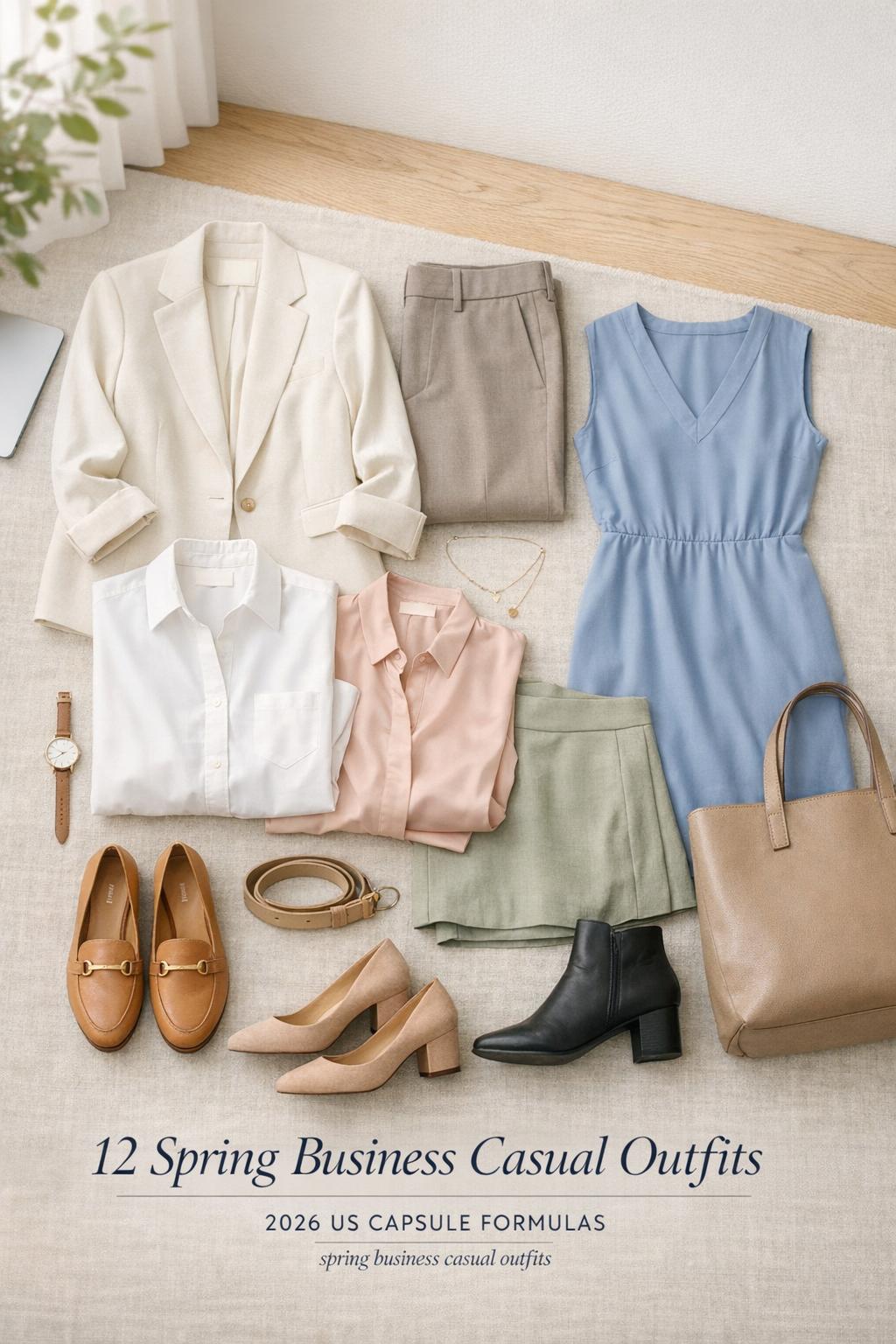
12 Spring Business Casual Outfits (2026 US Capsule Formulas)
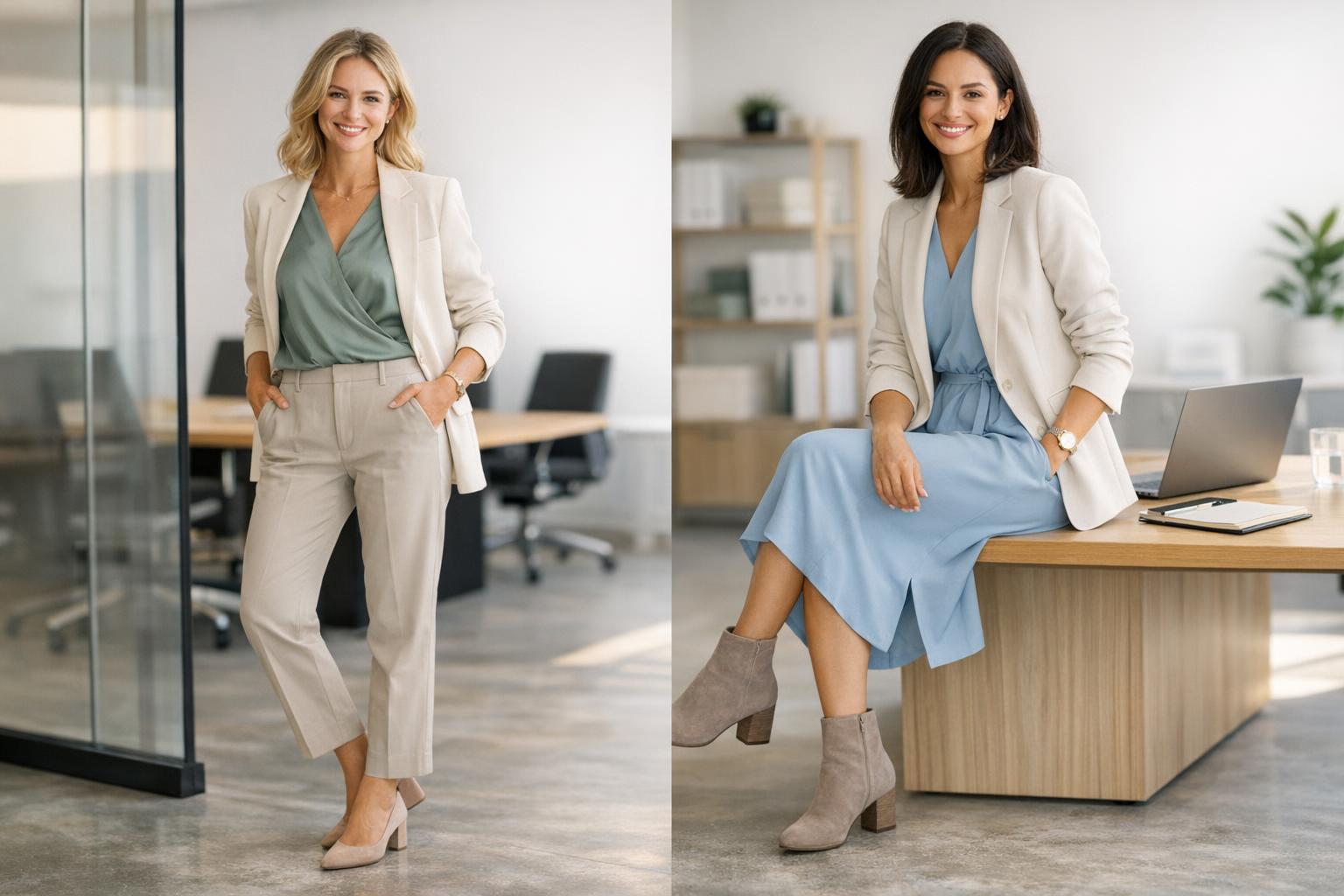
Spring Business Casual Outfits: A Complete US Guide for 2026
This post may contain affiliate links. As an Amazon Associate, we earn from qualifying purchases.
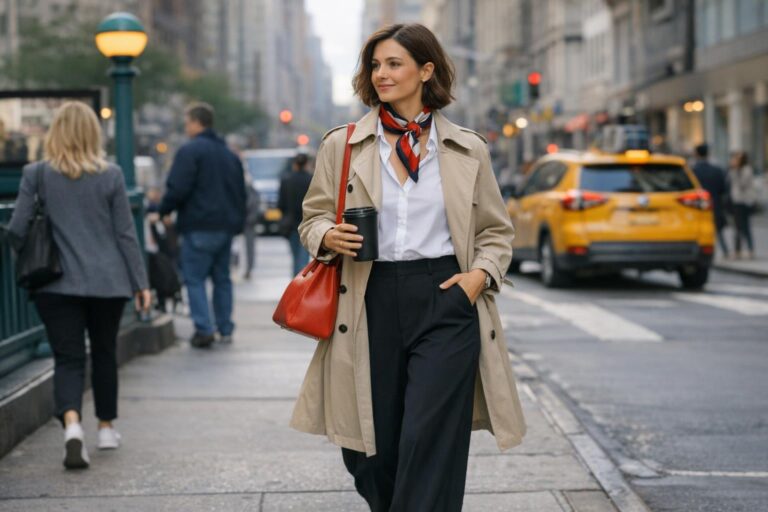
Spring business casual outfits are all about hitting the sweet spot between polished and comfortable while handling the season’s constant shifts—cool mornings, warmer afternoons, and the occasional need for a light layer indoors. If you’re building spring office outfits for women (or refreshing what you already own), the most reliable approach is to start with a few tailored foundations, then rotate color, texture, and accessories to create many office-appropriate spring looks without overthinking each morning.
This guide is designed to be practical and repeatable: you’ll get clear definitions of what “spring business casual” means in 2026, a simple foundation wardrobe, fabric and color direction (neutrals, pastels, and soft brights), a capsule blueprint that turns a handful of staples into 20 outfit ideas, and role-based guidance for different workplaces—from corporate/finance to creative/tech to client-facing roles. You’ll also find transition layering tips, accessory and shoe guidance (loafers, block-heel pumps, ankle boots), a wardrobe-building checklist (with budgeting and maintenance), and a categorized outfit gallery you can use to recreate looks quickly.
The Fashion-Note Edit
Five effortless pieces to refresh your everyday wardrobe
A polished, practical edit for workdays, weekends, and everything in between.

The Drop
Women’s Blake Long Blazer
A longline, tailored blazer with a notched collar and a single-button closure—an easy layer for denim, dresses, or office-ready looks.
Shop the blazer
Amazon Essentials
Women’s Lightweight Crewneck
A soft, lightweight sweater with a clean crew neckline—the kind of reliable layer that works from cool mornings to air-conditioned spaces.
Shop the sweater
Amazon Essentials
Women’s Loafer Flat
A classic flat loafer that gives casual outfits a more polished finish and pairs naturally with tailored pants, skirts, and straight-leg jeans.
Shop the loafers
Levi’s
Women’s 501 90s Jeans
A relaxed, vintage-inspired take on the iconic 501 silhouette—made for an easy, lived-in look without the thrift-store search.
Shop the jeans
Colorfulkoala
High-Waisted 7/8 Leggings with Pockets
Soft, four-way-stretch leggings with side pockets and a high-rise waistband—designed for movement, errands, and off-duty comfort.
Shop the leggings
Affiliate disclosure: This section contains affiliate links. If you make a purchase through these links, I may earn a commission at no additional cost to you. Product selection, pricing, availability, and delivery terms may change—please review the current details on Amazon before purchasing.
As an Amazon Associate I earn from qualifying purchases.
What “Spring Business Casual” Really Means in 2026
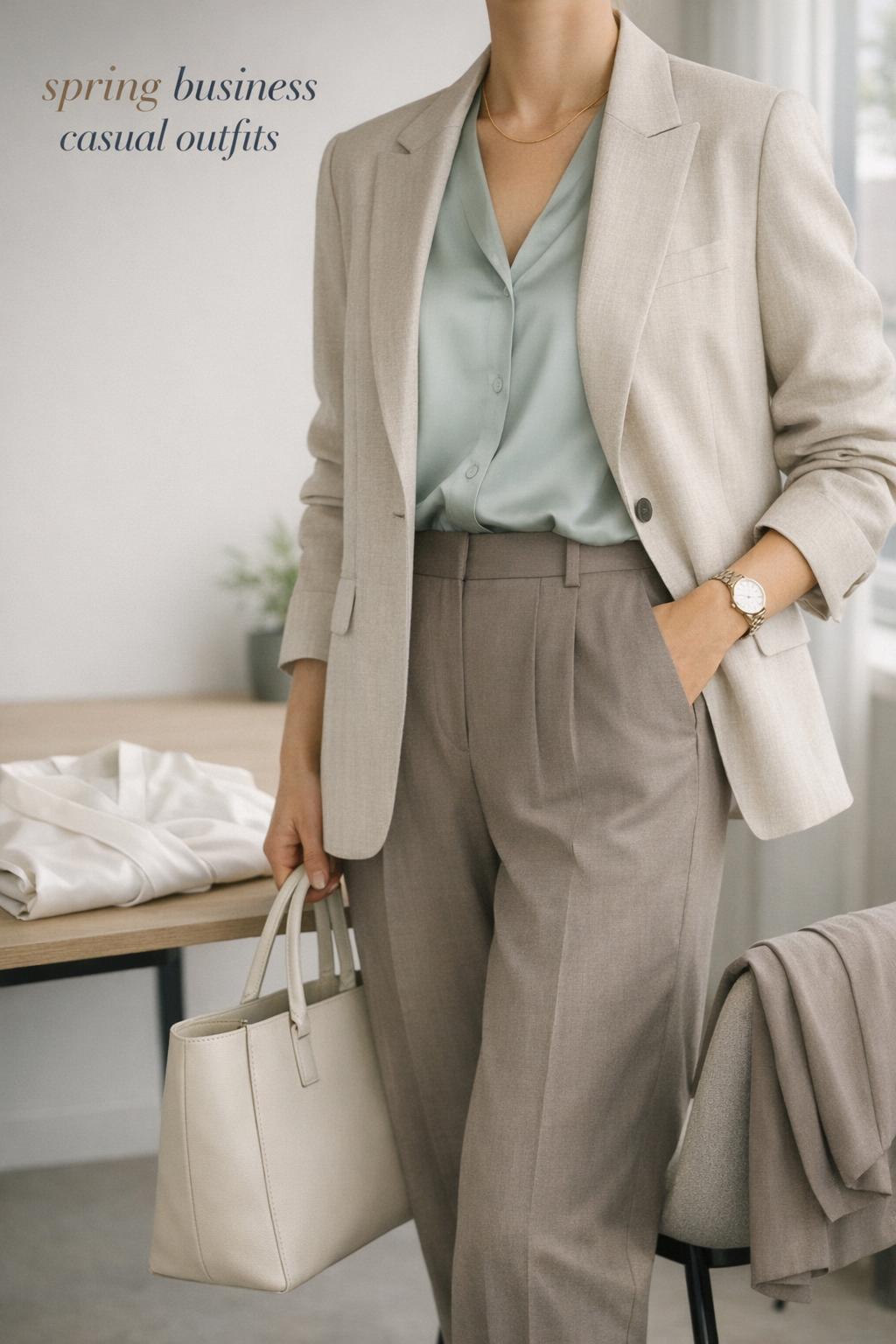
“Business casual” isn’t one rigid uniform; it’s a spectrum that depends on your workplace, your role, and whether you’re client-facing. In general, spring business casual combines professional shapes (think blazers, tailored trousers, midi skirts, structured dresses) with lighter seasonal fabrics and more relaxed styling than full suiting. Spring adds a specific challenge: you need breathability and ease, but you also need layers that look intentional when the office is chilly.
Your wedding style is personal.
Your plan should feel that way, too.
Zarellea keeps your guest list, budget, vendors, and every next step beautifully organized — so you can focus on the moments that feel like you.
In 2026, the most wearable interpretation keeps tailoring at the core while using softer color paths and transitional textures. That’s why you’ll see so many spring workwear looks built around blazers, trousers, button-downs, knit tops, and midi-length silhouettes. Patterns like stripes and florals show up often as a “spring signal,” but they work best when balanced with clean neutrals and simple accessories.
Tip: If you’re uncertain where your office lands on the spectrum, dress slightly more polished for your first wear of a new outfit formula. A blazer over a simple top and tailored pants is one of the easiest “safe” spring business casual outfits—then you can relax details later (a softer knit, a more casual shoe, or a less structured bag) once you see what fits your environment.
Core Wardrobe Foundations for Spring
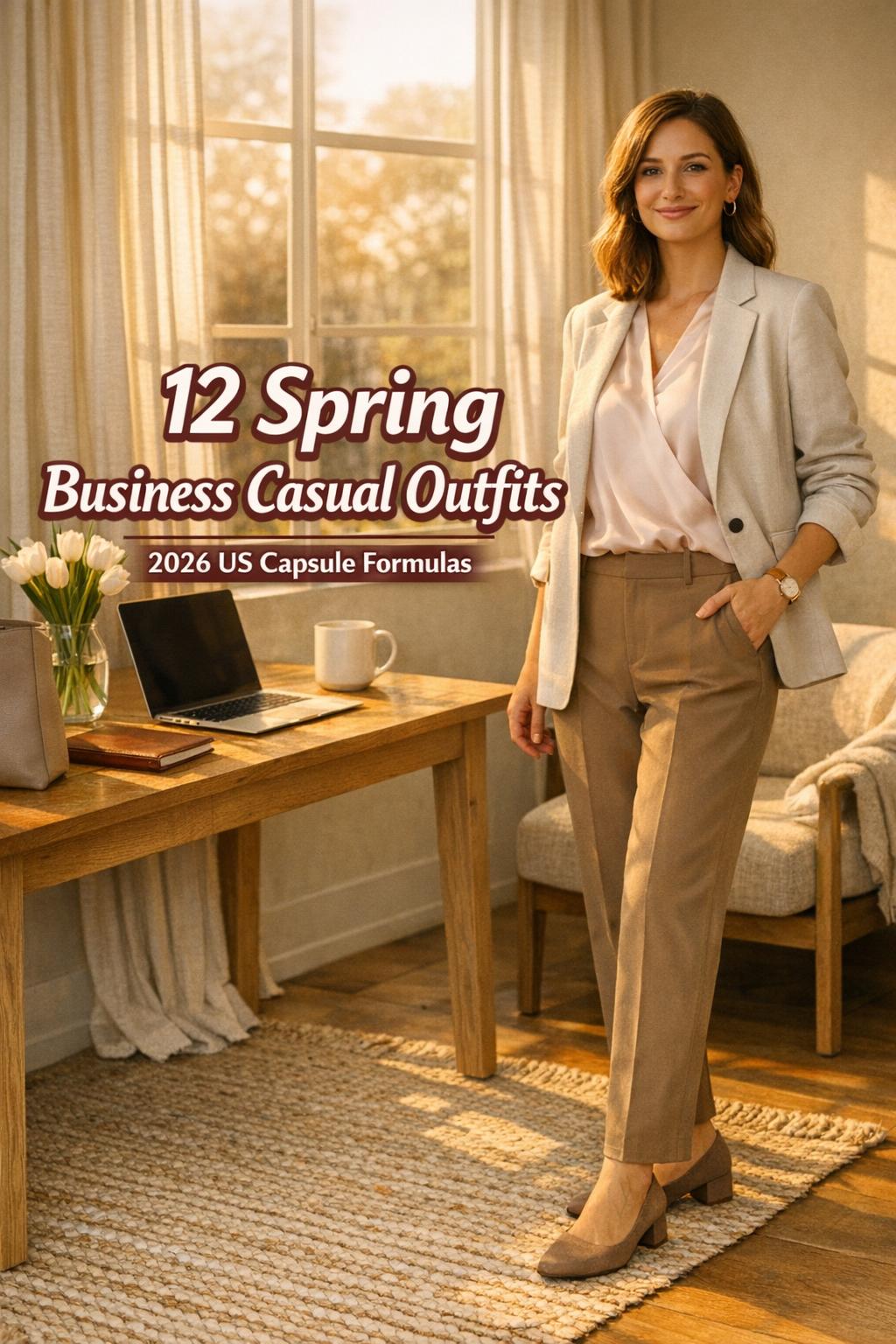
The best spring wardrobe is built to mix: a few consistent core pieces, then multiple outfit variations through color, pattern, and accessories. Most outfit-focused inspiration lists show what to wear, but the real unlock is understanding why those combinations work—tailoring plus seasonal fabric plus spring-appropriate color, repeated in different proportions.
The 5 essential pieces every spring business-casual closet needs
You can create a surprisingly large number of spring business casual outfits from five foundational pieces—especially if you choose them in neutral tones that pair well with pastels, soft brights, stripes, and florals.
- A light blazer (structured enough for meetings, easy enough for everyday)
- Tailored trousers (a clean, office-ready anchor for multiple tops)
- A polished blouse (works for desk days, presentations, and day-to-night transitions)
- A midi dress (easy one-and-done look with instant professionalism)
- A midi skirt (pairs well with knits, button-downs, and wrap blouses)
Tip: If you’re building a small spring workwear capsule, choose one piece that can act as your “look elevator.” For many people, that’s the blazer because it instantly makes a simple top-and-pants combo look deliberate—especially useful for hybrid days when you want comfort without looking too casual.
Fabrics that work in spring: breathable wools, cotton sateen, linen blends, silk, satin
Spring calls for fabrics that breathe while still holding shape. Breathable wools and wool blends keep tailoring crisp without feeling heavy. Cotton sateen offers a smooth, professional finish that doesn’t feel stiff. Linen blends are a warm-weather favorite because they read seasonal and relaxed while staying office-appropriate when cut into tailored silhouettes. Silk and satin (especially in blouses) add polish and softness—perfect for pairing with structured trousers or a skirt.
Tips: Keep an eye on how fabrics behave across your whole day. If your commute is warm but your office runs cold, a breathable base layer (like a blouse) plus a blazer that’s easy to remove is usually more practical than a thick sweater. If you love a soft sweater look, use it as a layer you can shed or pair it with a lighter bottom like a pleated skirt to keep the outfit seasonally balanced.
Color paths for spring: neutrals, pastels, and soft brights
Most spring office fashion is built from neutrals first, then lifted with color. Neutrals (like black, navy, beige, white, and soft gray) keep outfits grounded and professional. Pastels signal spring without feeling loud—especially when used as trousers, a blouse, or a blazer. Soft brights can work too, particularly as a single pop balanced by neutral tailoring.
Tips: When you wear a floral or a stripe, treat it as the “statement” and keep the rest of the outfit clean. When you wear monochrome (even in blush or other soft tones), focus on fit and texture—pinstripes, tweed, or a satin blouse can keep monochrome from looking flat.
Capsule Wardrobe Blueprint: 20 Outfits from 5 Staples
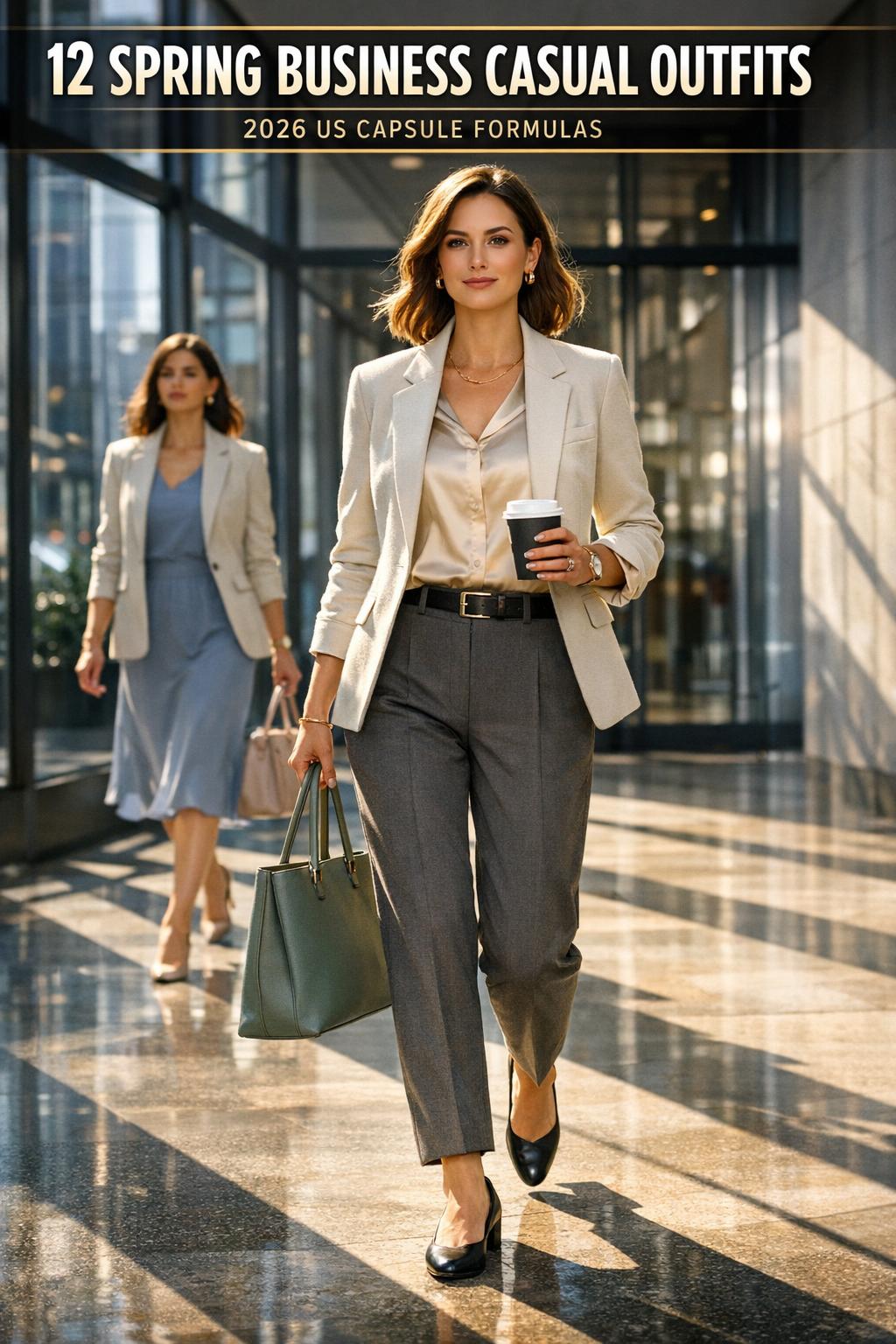
This capsule blueprint turns a handful of staples into a full month of outfit ideas. Use it as a “mix-and-match map” rather than a strict uniform. The goal is to make spring business casual easy: start with a core (blazer, trousers, blouse, midi dress, midi skirt), then rotate supportive pieces like soft sweaters, wrap blouses, button-downs, and smart casual shoes.
Outfit set A: Blazer + trousers (the fastest polished formula)
When you need to look professional quickly, blazer outfits for spring business casual are the reliable default. The trick is changing the vibe with color and texture—pastels, pinstripes, or a softer blouse.
- Soft blue blazer + tailored trousers + simple top for a clean, classic spring office look
- Wrap blouse + tailored pants + light blazer for a sharp but approachable meeting outfit
- White shirt + pastel pants + blazer for a relaxed spring office look that still reads professional
- Modern pinstripes + casual touch (structured trousers, softened by a simpler top) for a contemporary workwear feel
Tip: If you’re using a light blazer as your signature layer, keep at least one “backup” outfit version ready: switch the blouse to a satin finish or a button-down, and swap shoes from loafers to block-heel pumps. You’ll look intentionally dressed for a higher-stakes day without buying an entirely new outfit.
Outfit set B: Dresses and midi-length silhouettes (one-and-done spring polish)
Midi dresses and office-appropriate spring dresses are an easy way to look finished with minimal planning. The most common winning combination is a midi dress plus a light blazer or a refined layer, then shoes chosen for your commute and workplace.
- Light blue blazer + floral dress for a spring-forward, office-ready outfit
- Chic midi dress + white sneakers for a hybrid-friendly day (best in more relaxed offices)
- Monochrome minimalism dress styling with sleek layers for a refined, modern silhouette
- Day-to-night transition: midi dress + blazer + simple accessories that can handle a dinner after work
Tips: If your workplace is conservative, keep the dress silhouette clean and rely on the blazer to “business it up.” In more relaxed environments, sneakers can work when the dress is midi length and the overall styling is neat (clean lines, minimal accessories).
Outfit set C: Skirts with tailored tops (spring texture + movement)
Skirts are a spring staple because they add movement and a seasonal feel without sacrificing professionalism. Pair a midi skirt with a polished top (button-down, wrap blouse, satin blouse) and anchor it with structured accessories.
- Soft sweater + pleated skirt for an office-appropriate look that handles cooler mornings
- Satin blouse + paper bag pants alternative (swap in a midi skirt for a dressier variation)
- Striped button-down + midi skirt for a smart, classic spring workwear outfit
- Floral spring chic: midi skirt with subtle floral pattern + neutral top to keep it balanced
Tip: When a skirt already brings volume or movement (like pleats), keep the top more streamlined. Wrap blouses work especially well because they look tailored without feeling stiff, and they create a clean shape under a blazer if you need an extra layer.
Outfit set D: Pantsuits with soft knits (tailoring without feeling heavy)
Spring doesn’t mean abandoning structure—it means making structure breathable and wearable. A pantsuit effect (coordinated blazer and trousers) feels powerful, and you can soften it with knit textures or a blouse with a smooth finish.
- Monochrome in blush: blazer + trousers + neutral top for a soft, modern spring suit moment
- Timeless heritage with tweed: use texture to add depth while keeping the silhouette office-ready
- Monochrome minimalism with sleek trousers + light blazer for a clean, pared-back look
- Striking monochrome in stripes: keep stripes subtle and pair with simple accessories
Tips: Monochrome looks read more intentional when the fit is sharp and the fabrics contrast slightly (for example, a matte trouser with a smoother blouse). Keep accessories minimal to let the silhouette do the work.
Outfit set E: Casual pieces for hybrid/remote days (still work-ready)
Hybrid schedules and work-from-home days often call for comfort, but “comfortable” doesn’t have to mean sloppy. The goal is smart casual spring outfits that still look professional on camera or for quick office drop-ins.
- White T-shirt + dress pants for a simple spring uniform that works with loafers or ankle boots
- Paper bag pants + satin blouse for an easy-to-style outfit with polish and comfort
- Relaxed beige trousers + striped button-down for a clean look that feels lighter than winter dressing
- Vibrant pink shirt + denim (only if your office explicitly allows it) for a color-pop spring look
Tip: If you’re using casual anchors (like a T-shirt), balance the outfit with tailored dress pants, a structured layer, and office-ready shoes. That’s what keeps the look in the business casual lane instead of weekend casual.
By-Role Breakdown: Industry-Specific Guidance
One reason business casual feels confusing is that “appropriate” changes dramatically by industry. Use this section to calibrate your outfits to your workplace, then pull specific combinations from the capsule blueprint above.
Corporate/finance
Corporate environments usually reward structure and restraint. Focus on tailored trousers, a polished blouse, and a light blazer. Monochrome minimalism, subtle pinstripes, and refined textures like tweed can all work well. Keep florals understated and let them act as an accent rather than the entire statement.
Tip: If you’re client-facing or presenting, default to blazer + tailored pants and keep accessories understated. You can still nod to spring through pastels (like pastel pants or a soft blue blazer) without stepping outside conservative norms.
Creative/tech
Creative and tech workplaces often allow more relaxed silhouettes and bolder styling choices. This is where smart casual spring outfits—like a white T-shirt with dress pants, or monochrome looks in blush—can feel natural. Stripes, color pops, and more casual footwear can work, as long as the outfit remains neat and intentional.
Tip: Keep one “upgrade layer” at your desk or in your bag. Adding a light blazer over a simpler base outfit is the easiest way to shift from casual internal meetings to a more formal moment without changing entirely.
Education/healthcare
In education and many healthcare-adjacent roles, you often need outfits that look professional but prioritize movement and comfort. Dresses and midi skirts can work well when they’re easy to move in, and soft sweaters with pleated skirts can help with early spring chill. Choose fabrics that breathe and layers that can handle changing temperatures between classrooms, offices, and hallways.
Tip: Use a repeatable formula: one comfortable base (tailored trousers or a midi dress) plus one professional topper (blazer or refined sweater). This keeps decision fatigue low across busy weeks.
Client-facing roles
When your role involves clients, your clothes function as part of your professional brand. Stick to office-appropriate spring looks that read polished at a glance: blazer + trousers, wrap blouse + tailored pants, or a midi dress with a structured layer. Patterns like stripes are often a safe way to add spring interest; florals can work best when balanced with clean neutrals.
Tip: Build a “client-ready” mini set you can repeat: one light blazer, two polished blouses (one satin/silk-like, one classic button-down), and tailored trousers. Rotate accessories to keep it fresh while staying consistent and professional.
How to Transition from Winter to Spring (Layering and Temperature Swings)
Spring style is often less about brand-new pieces and more about strategic layering. You want layers that add warmth in the morning and look natural when removed later. The most common spring business casual success comes from keeping the base outfit office-ready on its own, then adding a light blazer or refined layer that can come off without disrupting the look.
Morning chill to afternoon heat
Start with a breathable base: blouse + tailored pants, or a midi dress that can stand alone. Add a light blazer or soft sweater for your commute and early hours. As the day warms up, you can remove the layer and still look polished. This is where fabrics like breathable wools, cotton sateen, linen blends, silk, and satin shine—they look professional without trapping heat.
Tip: Keep your outfit’s “core” slightly more professional than you think you need. That way, when the blazer comes off, you don’t fall into overly casual territory.
Layering pieces that don’t overpower outfits
In business casual, layers should support the outfit rather than dominate it. A light blazer is the most versatile. A soft sweater works well when paired with a more structured bottom (like tailored trousers or a pleated skirt). If you’re leaning into spring color, choose one layer as the color feature (soft blue blazer, blush monochrome, pastel pants) and keep everything else calm.
Tip: If your outfit includes a bold element (pinstripes, florals, a vibrant pink shirt), keep your topper neutral and your accessories minimal. This makes the look feel intentional instead of busy.
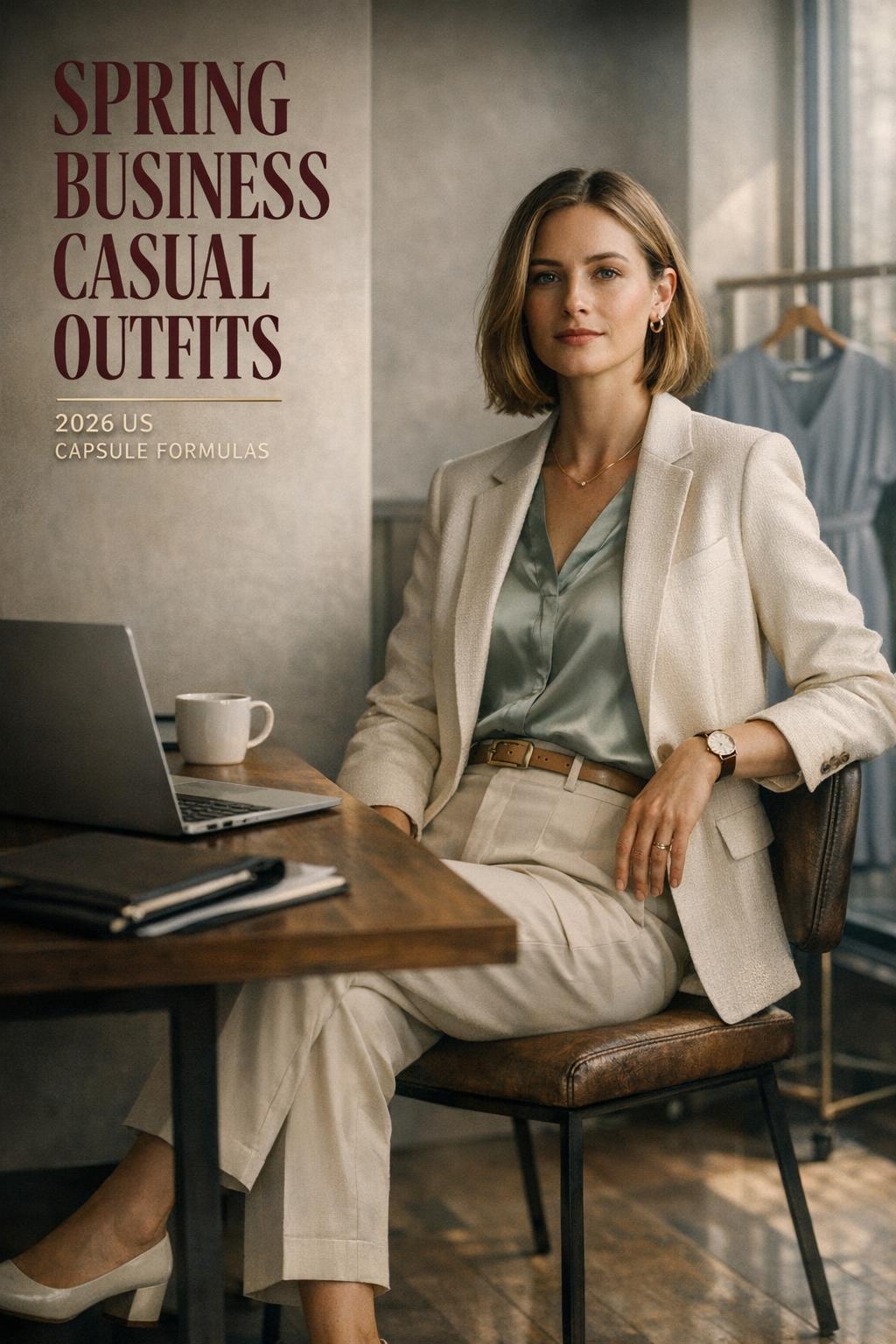
Color, Patterns, and Accessories That Elevate Spring Looks
Spring is the season where small styling changes make a big impact. You don’t need a closet overhaul—just a few thoughtful choices in pattern, color placement, and accessories. The most reliable spring professional attire uses one focal point and supports it with tailored basics.
Pattern mix guidance (stripes, florals, subtle prints)
Stripes often read crisp and modern, especially for office shirts and subtle monochrome looks. Florals are a classic spring option that can still be business casual when the silhouette is tailored (like a floral dress under a light blazer) or when the floral is balanced with neutrals. If you’re mixing patterns, keep one of them subtle and let the other be the main statement.
Tip: If you’re new to patterns at work, start with one patterned piece at a time: a striped button-down with relaxed beige trousers, or a floral dress paired with a clean blazer. Once that feels comfortable, you can explore slightly bolder combinations while staying within office-appropriate spring looks.
Accessorizing without overdoing it
Accessories should sharpen the outfit’s message: polished, calm, capable. In spring, you can keep accessories lighter and more minimal—especially if you’re already using color through pastels or soft brights. If your outfit is monochrome, a small contrast through accessories can add dimension without disrupting the sleek feel.
Tip: Use accessories to control formality. The same base outfit (blouse + tailored pants) can look more formal with structured accessories, or more relaxed with simpler ones. This lets you reuse pieces across different kinds of workdays.
Shoes that complete the look (loafers, block-heel pumps, ankle boots)
Shoes can define whether an outfit feels “office” or “almost office.” Loafers are a dependable choice for spring workwear because they look professional and feel practical. Block-heel pumps can elevate a simple outfit for meetings or client days while still being wearable. Ankle boots work well in early spring when the weather is unpredictable, especially with tailored trousers or midi dresses.
Tip: When you’re wearing lighter spring colors (pastel pants, soft blue blazer, blush monochrome), keep shoes classic and clean to maintain a professional balance.
Practical Wardrobe-Building Checklist (Budget, Maintenance, and Planning)
Creating spring business casual outfits gets much easier when you plan for versatility. Instead of buying many “single-use” outfits, build a small set of pieces that mix well, then add one or two seasonal accents like a floral dress or a pastel trouser. This section helps you build a wardrobe that’s repeatable, maintainable, and aligned with your workplace.
Budget-friendly build vs. premium upgrades
A budget-friendly approach focuses on the items you’ll wear most: a light blazer, tailored trousers, and a few tops that rotate easily (white shirt, wrap blouse, satin blouse). Premium upgrades are most worthwhile when they improve fit, comfort, or the look of your everyday uniform—especially in tailored pieces that hold shape across many wears.
- Start with: blazer + tailored trousers + two polished tops (white shirt and satin blouse are easy options)
- Add next: midi dress and midi skirt for warm days and fast one-and-done outfits
- Accent options: stripes (button-down) and florals (dress or skirt) for spring character
Tip: If you’re building slowly, focus on outfits you can wear in multiple contexts: a wrap blouse and tailored pants can look normal at your desk, appropriate in a meeting, and easy for after-work plans.
Care tips to extend garment life
Spring fabrics often feel lighter, so basic care matters. Keep blazers and tailored trousers in good shape by rotating wears and storing them neatly. Blouses in silk or satin benefit from gentle handling and thoughtful storage so they keep their finish. Linen blends can look intentionally springy, but they still look best when your overall outfit is neat and tailored.
Tip: If you repeat outfits often (as most people do in real life), vary the “top layer” and accessories more than the base pieces. It reduces wear on the same items while still giving you fresh combinations.
Where to buy: online and brick-and-mortar
Spring office outfits are easiest to shop for when you have a plan: start with your five staples, choose a neutral base color path, then select one or two spring accents (pastels, stripes, florals). Whether you shop online or in-store, prioritize fit and comfort, then add trend elements through color and pattern rather than overly specific silhouettes that are hard to rewear.
Tip: If you’re shopping online, aim to buy pieces that fit into at least three outfits you already know you’ll wear (for example: a satin blouse that works with tailored trousers, a midi skirt, and under a blazer).
Visual Gallery: 30+ Spring Business Casual Outfit Ideas (Categorized)
Use this gallery as a practical menu of spring business casual outfits. Each idea is intentionally built from the most common, office-appropriate spring building blocks: blazers, tailored trousers, wrap blouses, button-downs, midi dresses, pleated skirts, pinstripes, stripes, florals, and modern monochrome. Treat these as “recreate the look” prompts—swap colors within the same formula to match your closet and your workplace.
By color family (neutrals, pastels, soft brights)
- Neutral base: light blazer + tailored trousers + white shirt
- Neutral base: striped button-down + relaxed beige trousers
- Neutral base: soft sweater + pleated skirt in a classic tone
- Pastel focus: white shirt + pastel pants for a relaxed spring office look
- Pastel focus: soft blue blazer + trousers (or tailored pants) for a clean spring suit feel
- Pastel focus: monochrome in blush with sleek trousers
- Soft bright pop: vibrant pink shirt + tailored trousers (or denim only if allowed)
- Soft bright accent: satin blouse in a spring tone + paper bag pants
- Monochrome minimalism: sleek trousers + simple top + light blazer
- Striking monochrome in stripes: keep accessories minimal for a crisp finish
By garment type (blazer, dress, skirt, trousers)
- Blazer outfit: wrap blouse + tailored pants + light blazer
- Blazer outfit: soft blue blazer + trousers + neutral top
- Blazer outfit: pinstripes with a casual touch (tailored base, simple top)
- Dress outfit: light blue blazer + floral dress
- Dress outfit: midi dress + structured layer for meetings
- Dress outfit: midi dress + white sneakers for a relaxed office (if appropriate)
- Skirt outfit: soft sweater + pleated skirt
- Skirt outfit: satin blouse + midi skirt + loafers
- Trouser outfit: white T-shirt + dress pants + blazer as needed
- Trouser outfit: paper bag pants + satin blouse
By weather/temperature feel (early spring vs. late spring)
Early spring tends to favor layered outfits: blazers, soft sweaters, and closed-toe shoes like loafers or ankle boots. Late spring tends to favor breathable fabrics and one-and-done silhouettes like midi dresses and lighter blouses with tailored trousers. If you’re planning your week, build two “early spring” formulas and two “late spring” formulas, then rotate based on the forecast and office temperature.
- Early spring: soft sweater + pleated skirt + ankle boots
- Early spring: light blazer + tailored trousers + wrap blouse
- Early spring: tweed texture + sleek trousers + simple top
- Late spring: satin blouse + paper bag pants + loafers
- Late spring: midi dress + light blazer (optional) + block-heel pumps
- Late spring: white shirt + pastel pants + minimal accessories
- Anytime: striped button-down + relaxed beige trousers for a clean workwear baseline
- Anytime: monochrome minimalism with sleek trousers and a light topper
Tip: If you’re building outfit photos or notes for yourself, label them by scenario (meeting day, hybrid day, client day) and by “layering level” (needs blazer, optional blazer, no blazer). That makes the morning decision fast and reduces the risk of ending up too warm or too casual.
Your Spring Business Casual Outfit Framework
The easiest way to dress well all spring is to rely on a repeatable structure: start with tailored foundations (blazer, trousers, blouse, midi dress, midi skirt), then adjust for your role, your office’s formality, and the day’s temperature. Use neutrals for consistency, then add spring personality through pastels, soft brights, stripes, and florals—keeping one focal point per outfit so the result stays professional. With a small capsule and a clear set of outfit formulas, spring business casual stops being a daily puzzle and becomes a system you can trust.
FAQ
How do I dress business casual in spring if my office allows jeans?
If your office allows jeans, keep the rest of the outfit clearly professional: add a light blazer and a polished top like a satin blouse, wrap blouse, or crisp button-down, and finish with office-ready shoes such as loafers, block-heel pumps, or ankle boots. This balance helps the outfit stay in the business casual lane rather than looking like weekend wear.
What counts as “business casual” in conservative environments?
In conservative settings, rely on structured pieces and minimal styling: tailored trousers, a polished blouse, and a light blazer are the safest core. Use spring updates through subtle pastels, refined stripes, or understated florals, and keep accessories simple so the overall look reads professional and client-ready.
How can I build a spring workwear capsule wardrobe on a budget?
Start with the highest-utility items that create the most outfits: a light blazer, tailored trousers, and two polished tops (for example, a white shirt and a satin blouse). Then add a midi dress and a midi skirt for warm days and easy outfit variety; choose neutral base colors so everything mixes well, and add one spring accent like stripes or a floral piece.
What are the easiest spring business casual outfits for busy mornings?
The fastest formulas are blazer + tailored trousers + polished blouse, or a midi dress with a light blazer. These combinations look intentional with minimal effort, work across many industries, and handle spring temperature shifts because the layer can come off without the outfit looking incomplete.
How do I wear pastels to work without looking too casual?
Use pastels in tailored shapes—such as pastel trousers or a soft-toned blazer—and keep the rest of the outfit neutral and structured. Pair with a crisp white shirt or a simple polished top, and choose clean, professional shoes to maintain an office-ready finish.
Are floral spring outfits appropriate for business casual offices?
Florals can be business casual when the silhouette is professional and the styling is balanced. A floral dress with a light blazer is a dependable option, or you can wear a floral skirt with a neutral blouse; keeping accessories minimal helps the look feel polished and workplace-appropriate.
What shoes work best for spring office outfits?
Loafers are a versatile everyday choice, block-heel pumps are ideal for meetings and more formal days, and ankle boots are useful in early spring when the weather is unpredictable. Select shoes that match your office’s formality and keep the overall styling neat so the outfit reads professional.
How do I make smart casual spring outfits look more professional for meetings?
Add structure and simplify: put on a light blazer over your base outfit, choose tailored trousers instead of more casual bottoms, and swap to more polished shoes like loafers or block-heel pumps. Keeping accessories understated also helps shift the outfit toward a meeting-ready, professional look.
Finish the look
The little extras that make a summer outfit feel complete
From beach days to city weekends, these easy pieces bring comfort, texture, and a polished finishing touch.

FENBEN
Straw Hobo Crossbody Bag
A handwoven straw bag with both short and crossbody straps—an effortless finishing touch for vacation looks and warm-weather outfits.
Shop the bag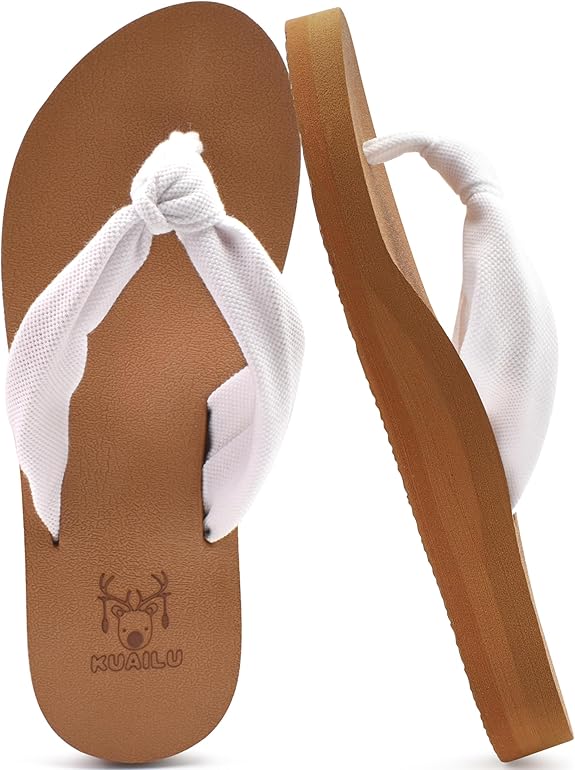
KuaiLu
Flip Flops with Arch Support
Cushioned, lightweight sandals with supportive arch design—a practical choice for beach trips, errands, and long summer walks.
Shop the sandals
baleaf
Athletic One-Piece Swimsuit
A functional one-piece with adjustable straps and moderate coverage, designed for swimming, training, surfing, and active beach days.
Shop the swimsuit
Astylish
Linen-Cotton Button-Down Shirt
A relaxed cotton-linen shirt with a collared V-neck and roll-up sleeves—easy to style over swimwear or with denim and shorts.
Shop the shirt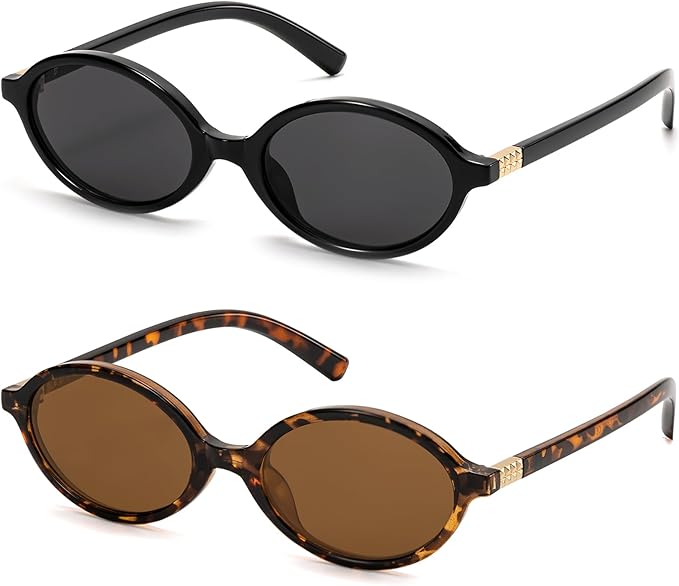
ViewJoy
Retro Oval Sunglasses
Small oval sunglasses with a 90s-inspired silhouette and UV400 lens protection—a quick way to add a vintage edge to everyday looks.
Shop the sunglasses
Affiliate disclosure: This section contains affiliate links. If you make a purchase through these links, I may earn a commission at no additional cost to you. Product selection, pricing, availability, and delivery terms may change—please review the current details on Amazon before purchasing.
As an Amazon Associate I earn from qualifying purchases.